Physics, Chemistry and Biology: Post your doubts here!

Messages
81
Reaction score
98
Points
28
here they r askng concept of felmings left hand rule
for a (i) using flemings rule we find direction of force is downwards
(ii) force acts cze magnetic field around current carring wire and dat of magnet concide
(iii) as both are reversed so direction remains same , if we reverse one so thn the direction would change
for (b) again we ll be using flemings left hand rule bt remember for negative charge , the direction of current ll be takn opposite
(ii) the path ll be parabolic
cn any1 explain , why its parabolic ?

Thanks :D that clears up my conflicts.
 
Messages
187
Reaction score
191
Points
53
Oh okay. Thanx bro

I didn't understand question 9: can u help me with it?
http://papers.xtremepapers.com/CIE/Cambridge IGCSE/Physics (0625)/0625_s11_qp_33.pdf

First their asking you for the direction of the force, you have a current carrying conductor which is the wire. You automatically decide that this questions requires the use of Flemings left hand rule. Now the current is pointing towards you, so you point your central finger towards you, you will observe that your thumb finger points down.

Since your thumb finger is pointing down, we immediately know that the force is pointing downwards due to the fact that your thu"M"b = Motion(Force).

For the next part, you're asked to write why this force exists in the first place. The current carrying conductor ( wire ), contains charges. These charges are in the form of electrons. When charges enter a magnetic field, they will always experience a force. So your best answer for this would be, The charges in the wire experience a force as they pass through the magnetic field lines.

Flip your hand upside down because the current direction is reversed, you will see that your thumb now points up. So the direction of the force is acting upwards.

For b) i) the magnetic field is acting into the paper. So use the right hand rule, and you'll see that the magnetic field points downwards. Drawn an arrow at P pointing down.

ii) As the magnetic field is a curved path going downwards, the particle will also follow a curved path, because it is now in the magnetic field.
 
Messages
187
Reaction score
191
Points
53
i knw dat bt cn we use the crookes ratemeter exp for thx
Xylferion cn u ans ?

There's no need to go all complicated and include stuff like the radiometer. Instead there's a much simpler experiment than what either of you want to use.

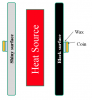
Bring two surfaces, one black and the other white, close to a heat source. Attach a Coin to wax, and the wax to both surfaces.

The better absorber will melt the wax and the coin will fall, the poor absorber will absorb less heat and the coin will still stick to the wax.
 

Attachments

  • Screen shot 2014-05-19 at 12.15.32 AM.png
    Screen shot 2014-05-19 at 12.15.32 AM.png
    18.8 KB · Views: 9
Messages
187
Reaction score
191
Points
53
How to draw? I can't do it!!
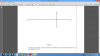
View attachment 43131

The focal length is 3.0 cm. That means 3.0 cm from the centre of the lens. You draw this on both sides of XY, to the left and to the right. Then you label these points as F.

Next it says that your object is at the 2.0 cm mark to the left of the lens, mark this point, and draw an object 2.0 cm high.

Draw a line to XY from the top of your 2.0 cm line, and draw a line from the top of your 2.0 cm line, that intersects with the centre of line XY.

Extend both these lines and you will see an image form behind your object. This image is virtual and magnified.

Here's one tip I can give you, whenever your object is in between the lens and F. The image produced will always be virtual and magnified.
 
Messages
6,440
Reaction score
31,077
Points
698
Messages
6,440
Reaction score
31,077
Points
698

For this, you should remember that if a body is dropped from a certain height, it's final velocity is given by v = acceleration due to gravity * time = gt.
So, to find time taken for stone to drop, since the stone takes the same time to drop as sound from the boat takes to reach the listener.
→ Time = Dist (btw boat and man)/ Speed (of sound)
t = 800/320 = 2.5s
Substituting in v = gt → v = 10 * 2.5 = 25 m/s

Hope you get it. :p
 
Messages
81
Reaction score
98
Points
28
oh, alright thanks :) then i lost at least 1 mark today...

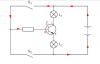
wait!! current may flow, but the polarity may differ, and the reversed battery will be damaged.
Now three DC batteries/Sources are connected in series,while the one is of reverse polarity of the 2 others ( that cause to establish two currents with opposite direction of each other). Under such a series connection, the resultant voltage is measured by subtracting the lower voltage from the higher one. And finally direction of current can be determined after we calculate the resulting voltage.
 
Messages
1,095
Reaction score
899
Points
123
wait!! current may flow, but the polarity may differ, and the reversed battery will be damaged.
Now three DC batteries/Sources are connected in series,while the one is of reverse polarity of the 2 others ( that cause to establish two currents with opposite direction of each other). Under such a series connection, the resultant voltage is measured by subtracting the lower voltage from the higher one. And finally direction of current can be determined after we calculate the resulting voltage.
how cn the current flow , as it would act like a barrier and so break the circuit bt i guess there ll be a p.d across the batteries
 
Messages
5,753
Reaction score
26,985
Points
698
COULD? COULD?? You surprise me, Phoenix Blood
Begging your heart out for a leaked paper that's due tomorrow and mulling over whether it COULD be cheating? Carry on, everything's perfectly okay.
Shut you, understand? I'm not doing any sort of begging out here, nor did I have any intention of obtaining the paper. Keep your surprises to yourself- i don't need telling. Over.
 
Messages
81
Reaction score
98
Points
28
how cn the current flow , as it would act like a barrier and so break the circuit bt i guess there ll be a p.d across the batteries

P.D is the energy used to push th current, so if two current are pushing against each other, the one which has more volt will be able to push the other one (she mentiond 3 batteries, and one is reversed) so its 2:1, in small circuit i dont think there may be a large damage, so stronger current will flow but with less volts and the pole of the current may be reversed.
 
Top