- Messages
- 105
- Reaction score
- 222
- Points
- 53
^^^^^ I CHANGED THE LINK PLZZ CHECK ITS NOVEMBER 08
🚀 NEW from the xtremepape.rs team: AI exam prep — 150,000+ worked solutions, and it marks your handwritten working from a photo. Sign in with your forum account & try it free → prepare.xtremepape.rs


I can't understand the last part could you please explainWow you're quite good in Chemistry! I couldn't even come that far in the question .... Thanks for the solution.. (Although most of it went over my head?
Could you please. Explain the last part of your explanation starting from (2x+3)Whoa~~ This question is sooo hard
First, I attempt to work out the no.of moles of the metallic salt and also sodium sulphite by using the volume and concentration given. Once you worked out the answer, you should get: no.of moles of metallic salt= 5 x 10^-3 moles and no.of moles of sodium sulphite(Sulphite ion)=2.5 x 10^-3 moles. Next you will need to work out the mol ratio of metallic salt to sulphite ion which can be done by simply (5x10^-3)/(2.5x10^-3) = 2/1 so the ratio is 2:1. This means that two moles of metallic salt is required to react with one mole of sulphite ion. Next you will need to look at the sulphite ion half formula and notice that there are 2 electrons on the right side, so you can deduce the half equation for the metallic salt by using the information given (Original Ox.no of metallic salt is +3). My half equation for metallic salt is: 2X3+ + 2e- ---> 2X2+(I put 2X3+ instead of X3+ here because two moles of metallic salt is required to react with one mole of sulphite ion. I put 2e- on the left because when you mix the two half equations together(half equation of sulphite and metallic salt), the 2e- on both side will be cancelled out. The product contain 2+ ions because the total number of charge on left must be equal to the total number of charge on the right. By calculation: ((2x +3) - 2)=+4(charge on left side), (2 x +2)= +4 so the charges on both side are equal). From the half equation of the metallic salt, you can clearly deduced that the new oxidation state of the metal is +2. So answer is B.
So hard~~ Plus the working is quite long. I am afraid I don't have enough time for this during exam...


Q7.dhttp://papers.xtremepapers.com/CIE/Cambridge International A and AS Level/Physics (9702)/9702_s11_qp_12.pdf
Q7 Q8 please ASAP .. with brief explaination !! thanks in advance


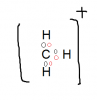
In which species does the underlined atom have an incomplete outer shell?
A Al 2Cl 6 B CH3+
C Cl 2O D H2Cl C•

student investigates four different fuels. Each fuel is used separately to raise the temperature of
1 dm3
of water from 20°C to 100°C. Each fuel undergoes complete combustion. All other
conditions are the same in each experiment.
Which fuel would produce the smallest amount of carbon dioxide in these experiments?
fuel energy released
per mole of fuel
A ethanol 1367kJ mol–1
B methane 890kJ mol–1
C methanol 715kJ mol–1
D propane 2220kJ mol–1
Ans is B
🚀 NEW from the xtremepape.rs team: AI exam prep — 150,000+ worked solutions, and it marks your handwritten working from a photo. Sign in with your forum account & try it free → prepare.xtremepape.rs