Need help with Maths(o level).

Messages
69
Reaction score
48
Points
28
Can someone help me with this question, plzz?
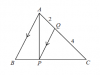
In the diagram, the points P and Q lie on the sides BC and AC of triangle ABC.
AB is parallel to QP.
AQ = 2 cm and QC = 4 cm.
The area of triangle CPQ is 6 cm2.
Find the area of
(a) triangle AQP [1]
(b) triangle ABC[1]
(c) triangle ABP [1]


(Its a nov 2012 paper 1 question)
 

Attachments
  • Capture.PNG
    Capture.PNG
    5 KB · Views: 13
Last edited:
Messages
3,412
Reaction score
9,812
Points
523
Can someone help me with this question, plzz?
In the diagram, the points P and Q lie on the sides BC and AC of triangle ABC.
AB is parallel to QP.
AQ = 2 cm and QC = 4 cm.
The area of triangle CPQ is 6 cm2.
Find the area of
(a) triangle AQP [1]
(b) triangle ABC[1]
(c) triangle ABP [1]


(Its a nov 2012 paper 1 question)

(1) AQP and CPQ have a common height, so ratio of their areas will be equal to ratio of their bases.

Area of AQP = 2/4 x 6 = 3cm^2

(2) Triangle CPQ and ABC are similar, so ratio of their areas is equal to the square of the ratio of their sides.

(4/6)^2 = 6/x

And you can find x which is equal to 13.5 cm^2

(3) AQP was 3 cm^2 and CPQ is 6 cm^2. So subtract these from 13.5 to get 4.5cm^2.
 
Messages
69
Reaction score
48
Points
28
(1) AQP and CPQ have a common height, so ratio of their areas will be equal to ratio of their bases.

Area of AQP = 2/4 x 6 = 3cm^2

(2) Triangle CPQ and ABC are similar, so ratio of their areas is equal to the square of the ratio of their sides.

(4/6)^2 = 6/x

And you can find x which is equal to 13.5 cm^2

(3) AQP was 3 cm^2 and CPQ is 6 cm^2. So subtract these from 13.5 to get 4.5cm^2.
Thanks a lot Dark Destination! :)
 
Top