- Messages
- 382
- Reaction score
- 1,405
- Points
- 173
🚀 NEW from the xtremepape.rs team: AI exam prep — 150,000+ worked solutions, and it marks your handwritten working from a photo. Sign in with your forum account & try it free → prepare.xtremepape.rs

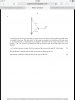
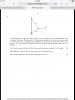
I will explain you th whole concept and try to understand ...I need some serious help in mechanics. In a question regarding the work done = change in total energy, I don't understand how to decide which one from K.E and P.E has a greater value so that I can subtract well. Please pleaseee help me understand the concept.
Here is an example:
http://papers.xtremepapers.com/CIE/Cambridge International A and AS Level/Mathematics (9709)/9709_s10_qp_41.pdf
qn no. 5(ii).. how do you decide which one (K.E/P.E) has a greater value?
I'll really reallyyy appreciate any help provided.
Thanks a lot
Thanks a lot for the explanation, I really appreciate it.I will explain you th whole concept and try to understand ...
First thing you need to consider , is to know if surface is smooth/ rough ( has friction )by reading question.
then follow the formula wd (workdone ) by driving force = wd by resistive force ( resisting motion ) +- K.E gained/lost +- P.E gained/lost.
if it increses in speed KE is gained ( Add in eqn ) if decreased in speed its decresed KE is lost ( subtract from eqn )..
If it increses in Height ( moves up ) PE is gained ADD in eqn ... and if comes down PE is lost and subtract in eqn
so when something is gained ADD and when lost MINUS as you see i wrote +- in eqn depending whether its lost or gained .
we know wd formula is = F * d
In this question ,,, here its same speed .. mean no gain/loss in KE .. so its not included in equation and there is no Wd by driving force so both are ZERO in eqn
So our eqn is wd (workdone ) by driving force = wd by resistive force ( resisting motion ) + K.E + P.E gained
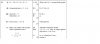
0 = 0.39 + 0 + mgh


To make it easier, integrate it separately:http://papers.xtremepapers.com/CIE/Cambridge International A and AS Level/Mathematics (9709)/9709_s08_qp_3.pdf
Please help me with qn no. 7(ii).
I got the partial fractions in (i) as:
1 + (1/2)(1/x+1) + (3/2)(1/x+3)
I'll appreciate any help. Thanks
ThanksTo make it easier, integrate it separately:
∫1 dx + 1/2∫ 1/(x+1)dx - 3/2∫1/(x+3) dx
x + 1/2ln(x+1) - 3/2ln (x+3)
Put the limits
3 + 1/2 ln4 - 3/2 ln 2
3 + 2/2 ln 2 - 3/2 ln2
3 - 1/2 ln2


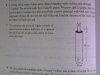

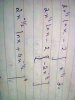
z^4 - 16 = (z^2)^2 - (4)^2Find factors of'
z^4 -16
Hello,
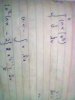
I hope it's readable.intergrate ∫(Inx)/(x^1/2) dx within the limits 4 to 1 ....can someone answer this question for me

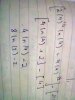
s=ut+1/2at^2A stone is projected vertically upward with a speed of 21 m/ s .find the distance travelled by the stone in the first 3 seconds of its motion . Plzzz anyone help me out
🚀 NEW from the xtremepape.rs team: AI exam prep — 150,000+ worked solutions, and it marks your handwritten working from a photo. Sign in with your forum account & try it free → prepare.xtremepape.rs