-
Prepare by Xtremepapers!
🚀 NEW from the xtremepape.rs team: AI exam prep — 150,000+ worked solutions, and it marks your handwritten working from a photo. Sign in with your forum account & try it free → prepare.xtremepape.rs
You are using an out of date browser. It may not display this or other websites correctly.
You should upgrade or use an alternative browser.
You should upgrade or use an alternative browser.
A level Biology: Post your doubts here!
- Thread starter XPFMember
- Start date

- Messages
- 924
- Reaction score
- 1,096
- Points
- 153
True, phospholipid has hydrophilic head, but this is a good thing because this property causes phospholipids to naturally form bilayers in water, and thus helps keep the cell environment inside and outside separate. To stabilize the cell, you need larger molecules that form a lot of bonds with water, in all directions. I think phospholipids aren't capable of this as effectively as glycocalyx can.but isnt this so tht the phospholipid molecules form hydrogen bonds with water?? as they r hydrophilic
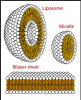
Here's a cool picture of what happens when you leave a bunch of phospholipids in water:

- Messages
- 121
- Reaction score
- 87
- Points
- 38
Mahmood Magdy, thanks for answering, could you PLEASE answer my question again ?
One thing I do not understand is what does it mean when they say in the mark scheme that ferric oxidizes other ores ? does this mean that the bacteria oxidizes ferrous to ferric and then ferric oxidizes sulfide to sulfate ? I dont understand this part at all,please answer me .
Thank you
So I believe you got everything upto that ferric point. Well, there are two modes of action of bacteria, it is either Direct Oxidation which is Sulfide to Sulfate, Ferrous to Ferric etc or Indirect Oxidation in which the products formed by the direct oxidation can be used later on, in this case Ferric could be used to oxidize other ores etc. At the very end of the process, the products are washed in ponds and the metal is collected as is gets displaced by the addition of scrap iron etc (reactivity series). Anytime

- Messages
- 121
- Reaction score
- 87
- Points
- 38
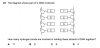
Between A and T are 2 hydrogen bonds and between C and G are 3 bonds
Add them up.Thanks.Between A and T are 2 hydrogen bonds and between C and G are 3 bonds
- Messages
- 155
- Reaction score
- 27
- Points
- 28
- Messages
- 155
- Reaction score
- 27
- Points
- 28

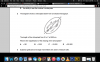
So you know the formula Magnification=size of image/size of object.This one as well. Multiple choice questions are my weakness. :'(
and they stated this 'The length of the chloroplast from X to Y is 5000nm.' and have given you a figure.
So if you measure that length in the figure you would get about 5cm=50mm=50,000micrometer=50,000000 nanometre.
Then this value 50000000 is the size of image and you have been given the size of object as 5000nm, just place them in the formula!
You will get the answer as 10,000. And that would be C.
I hope that helps.
And btw I think Bio ( as compared to others like Physics and Chem) paper is easier, just make sure that you know the chapter properly and make notes when doing MCQ's that helps you to revise important points. ( I made notes for two chapters if you want I can share
)
Last edited:
thnksTrue, phospholipid has hydrophilic head, but this is a good thing because this property causes phospholipids to naturally form bilayers in water, and thus helps keep the cell environment inside and outside separate. To stabilize the cell, you need larger molecules that form a lot of bonds with water, in all directions. I think phospholipids aren't capable of this as effectively as glycocalyx can.
Here's a cool picture of what happens when you leave a bunch of phospholipids in water:
View attachment 52582

- Messages
- 2,538
- Reaction score
- 17,571
- Points
- 523
https://docs.google.com/viewerng/vi...wp-content/uploads/2012/11/9700_s14_qp_21.pdf
https://docs.google.com/viewerng/vi...wp-content/uploads/2012/11/9700_s14_ms_21.pdf
Q4)b)i) I dnt get hw this qs and the markscheme answer is related
I mean why isnt it abt the b cell dividing into plasma cells and all
why this
Midnight dream is this the same qs?
https://docs.google.com/viewerng/vi...wp-content/uploads/2012/11/9700_s14_ms_21.pdf
Q4)b)i) I dnt get hw this qs and the markscheme answer is related
I mean why isnt it abt the b cell dividing into plasma cells and all
why this
Midnight dream is this the same qs?
Its pretty simple. What they are asking is how are antibody molecules formed. As our syllabus doesn't SPECIFICALLY describe how antibody molecules, we need a bit of reasoning here. Antibody molecules are, simply put, proteins, and we must outline the complete process of making proteins (transcription, translation .etc)https://docs.google.com/viewerng/vi...wp-content/uploads/2012/11/9700_s14_qp_21.pdf
https://docs.google.com/viewerng/vi...wp-content/uploads/2012/11/9700_s14_ms_21.pdf
Q4)b)i) I dnt get hw this qs and the markscheme answer is related
I mean why isnt it abt the b cell dividing into plasma cells and all
why this
Midnight dream is this the same qs?
If you mention about b cells dividing, you will mention they form plasma cells, plasma cells make antibodies, and you are right back at the question, because you haven't specified how are PLASMA CELLS making ANTIBODY MOLECULES.
- Messages
- 2,538
- Reaction score
- 17,571
- Points
- 523
Its pretty simple. What they are asking is how are antibody molecules formed. As our syllabus doesn't SPECIFICALLY describe how antibody molecules, we need a bit of reasoning here. Antibody molecules are, simply put, proteins, and we must outline the complete process of making proteins (transcription, translation .etc)
If you mention about b cells dividing, you will mention they form plasma cells, plasma cells make antibodies, and you are right back at the question, because you haven't specified how are PLASMA CELLS making ANTIBODY MOLECULES.
Qs like these kill me
i would ve never knownthank u soooo much ^_^
So all we do is explain protein synthesis?
Yup.Qs like these kill me
thank u soooo much ^_^
So all we do is explain protein synthesis?
- Messages
- 924
- Reaction score
- 1,096
- Points
- 153
I personally hated this question.Please helpp meee!!!!
You probably chose C as well, since minimum membranes CO2 passes through should be 4, (2 through capillary, 2 through squamous epithelial cell of alveolar wall). We learnt the three modes of CO2 transport, and the molecule remaining in blood plasma would be the case of minimum membrane crossing situation.
And oxygen, I thought, should be 5 since we're taught it goes into red blood cell and binds with haemoglobin. However, here's what the examiner's gotta say:
"Those candidates who realised that the question asked for the minimum number of cell membranes crossed by a molecule of oxygen and a molecule of carbon dioxide when passing to or from the alveoli to the capillary knew that 4 was correct for both. Option C was incorrectly selected by many candidates, but oxygen only passes through 5 membranes when it enters the red blood cell."
I might be over-reacting but come on! We never learnt oxygen had the choice to just not go into the RBC and choose not to bind with haemoglobin!
(Or at least I didn't...)

- Messages
- 1,229
- Reaction score
- 740
- Points
- 123
:s Ans is DIs the answer B?
And it's not C because it says:
"The data suggests... it TAKES 20 years for lung cancer to develop"
The key word is TAKES which implies that you will definitely not get lung cancer before 20 years, so C is wrong.

- Messages
- 85
- Reaction score
- 135
- Points
- 43

guys this question is about effect of temperature on oxygen uptake
what is Q10=2
- Messages
- 85
- Reaction score
- 135
- Points
- 43
it is specimen 07
- Messages
- 1,229
- Reaction score
- 740
- Points
- 123
why is D the answer and not C :/