- Messages
- 20
- Reaction score
- 6
- Points
- 13
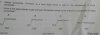
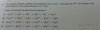
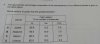
is the answer D? If it is, I assume due to the trend of thermal stability increasing down the group.anyone plz
🚀 NEW from the xtremepape.rs team: AI exam prep — 150,000+ worked solutions, and it marks your handwritten working from a photo. Sign in with your forum account & try it free → prepare.xtremepape.rs
is the answer D? If it is, I assume due to the trend of thermal stability increasing down the group.anyone plz
yes but how?is the answer D? If it is, I assume due to the trend of thermal stability increasing down the group.
A more proper way to represent these carbonates is in the form of BaCO3.CaCo3anyone plz
Give us some hard questions MetallicAnswered this for another user on here. Here is what I wrote:
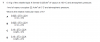
kay so in pentane we have CH3CH2CH2CH2CH3. What came to my mind first was, will it only occur at the terminals (-CH3) or in the middle too? I concluded that it occurs in the middle too by looking at the options. First option is 2. This MAY look like it means that it only occurs at -CH3 ends, but that would mean 1 possible propogation, not 2, because it's the same thing from both sides. Since 1 isn't an option, it MUST mean that propagation can occur on ANY carbon. Now you just have to see how many unique propagations can occur. One is CH3, second is at the CH2 next to it, and third is at the middle CH2. The fourth CH2 is the same as the second and fifth CH3 is the same as the first, so UNIQUE propagation steps are only 3. Answer is B. Notice how I cleared my concept using the answer options. You're going to have to keep an open mind like this.
EDIT: the equation they gave is of methane only to show a demonstration of what happens, they are asking about PENTANE.


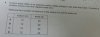
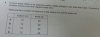
we have to make two equations which are equal to pressure bcz pressure is same in both...then solve it simultaneously
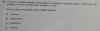
A more proper way to represent these carbonates is in the form of BaCO3.CaCo3
CaCo3 is common in all three of these,so the rest must be categorized in order of how much CO2 would be released on decomposition
Mg3(CO3)3 would release more CO2 than just MgCO3 and that in turn would release more CO2 than BaCO3 which is the hardest to decompose.
So the answer is D I assume?
Give us some hard questions Metallic
No my questions r childish have a look lmao :')Beautifully explained.
LOL I'm here relying on hard questions by you guys XD
Prayany last minute tips for tomorrow's p1?
Revise everything, so that no question related to learned/basic stuff get wrong.any last minute tips for tomorrow's p1?
Do you still need the answers or did anyone inbox you?Pray

I need short explanationDo you still need the answers or did anyone inbox you?
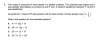
Tysm MAN!For the 1st one there is 1 lone pair and 2 bond pairs so a near trigonal planar shape would be formed if including the lone pair.The bond angle is hence 120 degrees
For the 2nd one change in oxidation in each Cr ion is -3 ,as two Cr ions are oxidized a total change of -6 is observed,as the reaction is redon 6 Fe ions must be reduced for this to occur
For the 3rd Group 1 metals ALWAYS form +1 ions,so the number of electrons in Na is 10 while this 1 electron is shared between the N3 ion to give a total of 3x7 +1 = 22 electrons
For the 4th just multiply percentage and mass and divide by 100 to get the average density,I assume the answer is D
For the 5th find the moles of oxygen,if it reacts with group 2 metal a molar ratio of 1:2 is used for calculation ,if it reacts with a group 1 metal a molar ratio of 1:4 should be used,both methods should be used to find the Mr ,and one comes off to be 46 which is far from calcium,hence wrong the other is 23 which is the Mr of Sodium
is the answer D ?can anyone help me with this i dont get it people are saying there are two methods to solve this but each giving a different result
🚀 NEW from the xtremepape.rs team: AI exam prep — 150,000+ worked solutions, and it marks your handwritten working from a photo. Sign in with your forum account & try it free → prepare.xtremepape.rs