- Messages
- 20
- Reaction score
- 5
- Points
- 13
🚀 NEW from the xtremepape.rs team: AI exam prep — 150,000+ worked solutions, and it marks your handwritten working from a photo. Sign in with your forum account & try it free → prepare.xtremepape.rs


You sir, deserve a f***ing medal....Thanks alot dudeQ21. According to principle of conversation of momentum :
Total momentum before emission (P1) = Total momentum after (P2)
P1 = o (stationary)
The nucleus emits one proton, so the daughter nucleus will have a nucleon number of A- 1.
It's mass will be (A-1)m, where m is the mass of one nucleon.
Momentum of nucleus = (A-1)mu
Momentum of proton = -mv
(Opposite signs because of the opposite directions of the velocities).
P2 = (A-1)mu - mv
P1 = P2
0 = (A-1)mu - mv
mv = (A-1)mu
v = (A-1)u (B)
No problemYou sir, deserve a f***ing medal....Thanks alot dude


I answered this on page 898. You check the answer there.Help pls!!
You apply v=f(lamda) to find the frequency. You know the wavelength of the visible spectrum ranges from 400nm to 700nm, and that the velocity of electromagnetic waves is 3x10^8.What do they mean by this?
Oh yeah i forgot to answer your main question lol.What do they mean by this?
Thank you so much!!!!! for the three answers, gosh I really need to pay more attention when I do the papers I did not see the word "visible" until now.You apply v=f(lamda) to find the frequency. You know the wavelength of the visible spectrum ranges from 400nm to 700nm, and that the velocity of electromagnetic waves is 3x10^8.
So 3x10^8=400x10^-9(f)
The f turns out to be 7.5x10^14 Hz. Hence, the order of frequency is 10^14 Hz(C).
Your welcome.Thank you so much!!!!! for the three answers, gosh I really need to pay more attention when I do the papers I did not see the word "visible" until now.
.
Thanks alot mann!!Q22. The gradient of displacement-time graph is velocity, so when the gradient is zero the velocity and thus KE are also zero.
The gradient is zero at time = 0, 0.5T, T, 1.5T and 2T
So the KE must be zero at those time coordinates too, only graph D shows this.
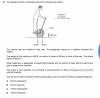
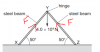
Q14. F is the force provided by each beam.
They act towards the hinge like this:
View attachment 64089
The system is in equilibrium, the vertical components = the weight and the horizontal components cancel out.
Vertical component of one beam = Fsin(50)
Total upward forces = 2Fsin(50)
2Fsin(50) = 4 x 10^4
solving for F gives F = 2.6 x 10^4 (A)
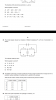
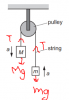
Q10.
View attachment 64090
ma = force in direction of motion - opposing force
for block M:
Ma = Mg- T
for block m:
ma = T - mg
Add equation 2 to 1:
Ma + ma = Mg- mg
Solving for a gives B as the answer.
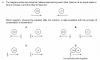
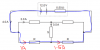
Q37.
View attachment 64091
Use KCL (I flowing into = I flowing out of a junction) to find the currents in the resistors.
Use KVL (EMFs = PDs across a closed loop) to find R.
EMF = PD
12 = (4)(0.5) + (1)(R) + (1.5)(R)
10 = 2.5R
4 = R (B).
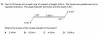
Q6. The sandbag was in motion in the balloon, meaning that it's initial velocity when dropped is 3m/s upwards.
It will have a parabolic motion while under acceleration of gravity.
The displacement of the bag during the 5 seconds will be the distance between its starting position and the ground, which is the height of the balloon when it was released.
S = ut + 0.5at^2
S = (-3)(5) + 0.5(9.81)(5)^2
S = 107.625 (B)
Note that the initial velocity and acceleration are in opposite directions.
Don't assume genderThanks alot mann!!
🚀 NEW from the xtremepape.rs team: AI exam prep — 150,000+ worked solutions, and it marks your handwritten working from a photo. Sign in with your forum account & try it free → prepare.xtremepape.rs