- Messages
- 57
- Reaction score
- 36
- Points
- 28
opps i meant Q 15 I knew this one it quite obvious. Thanku fr helping meCan u try 9,37,15?
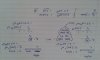
Q37- Theory -Kirchoff's rule One and Two
Hope this helps
The rest I think Farjad is correct
🚀 NEW from the xtremepape.rs team: AI exam prep — 150,000+ worked solutions, and it marks your handwritten working from a photo. Sign in with your forum account & try it free → prepare.xtremepape.rs
opps i meant Q 15 I knew this one it quite obvious. Thanku fr helping me
I don't know if that's possible.. although try this site justpastpapers.com it usually releases the papers 24h after the exam is conducted.does anyone know where to get the physics may/june 2017 paper 41. i know it's not yet uploaded but i was hoping if anyone of u knew how to get the paper

When a beta particle is emitted from the nucleus the nucleus has one more proton and one less neutron.And we know that an alpha makes it even lower..It's D need explanation
Oh damn y didn't i focused thanks a lot!When a beta particle is emitted from the nucleus the nucleus has one more proton and one less neutron.And we know that an alpha makes it even lower..
So, A & B no way then to make sure it's the minimum reduction we choose D.
Because, 2 betas would remove more than one beta which btw is obvious ...


Q4:T=1/f 1/50000 and divide this f by 2. This makes 1 complete wavelength in 2 divisions and hence you get C as the answer.the paper is here, can someone pls tell me how to get the ans for Q13 AND Q4
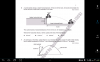 Question 6 Answeris B
Vertically:View attachment 62292 Question 6 Answeris B
Can u explain it step by step .ThanksVertically:
s=ut + 0.5at^2
2=0+10*t^2
t= 0.32
horizontally:
s=ut+0.5at^2
a is 0
6/0.632 = v Answer is b
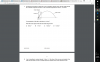
Ok so the cyclist is moving in two dimensions - both horizontally and vertically. Since these two components of motion are independent of each other, two distinctly separate sets of equations are needed - one for the cyclist's horizontal motion and one for its vertical motion.Can u explain it step by step .Thanks
Horizontally:
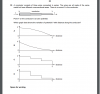
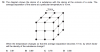
R= pL/A and Ohms Law V=IR hence the thickest conductor has the least resistance so the smallest Voltage drop across the thickest conductor.A is answer. The potential drop with distance is represented by grad of graph so the value of the grad drop should be the smallest for the thickest conductor Since thre is a potential drop gad is -ve.Q33 Needs an explanation. Answer is A.
Thanks a lot.R= pL/A and Ohms Law V=IR hence the thickest conductor has the least resistance so the smallest Voltage drop across the thickest conductor.A is answer. The potential drop with distance is represented by grad of graph so the value of the grad drop should be the smallest for the thickest conductor Since thre is a potential drop gad is -ve.

Thanks a lot.
🚀 NEW from the xtremepape.rs team: AI exam prep — 150,000+ worked solutions, and it marks your handwritten working from a photo. Sign in with your forum account & try it free → prepare.xtremepape.rs